Property in Catalonia
LEGAL UPDATE 28 September 2026
Buying Property in Catalonia? A New Asbestos Certificate Requirement Takes Effect in October 2026
Buying Property in Catalonia? A New Asbestos Certificate Is Now Required
If you are buying an older property in Catalonia, there is a new document to add to your due-diligence checklist.
Since 3 October 2026, Catalonia's **Law 8/2026 on the Eradication of Asbestos (*Llei 8/2026, de 2 de juliol, d’erradicació de l’amiant*)** has introduced a certificate requirement affecting the sale and rental of properties dating from before 2002.
The certificate states whether visible asbestos is present in the property and, if it is, provides information about its condition and the risk it may pose.
Which properties are affected?
According to the interim guidance issued by the Agència de Residus de Catalunya (Catalan Waste Agency), the requirement applies to properties dating from before 2002.
This date is significant because the marketing and use of asbestos-containing materials was prohibited in Spain from 2002.
If the transaction concerns an individual unit within a larger building—for example, an apartment or commercial premises—the certificate relates to that individual unit.
What does the certificate cover?
Pending the definitive implementing regulations, the certificate concerns the presence or absence of visible asbestos.
If asbestos-containing material is visible, the certificate must also address:
– its condition; and
– the risk it may pose to people.
The word visible is important. The certificate should not be understood as a guarantee that there is no concealed asbestos anywhere within the structure of the property.
This distinction may be particularly relevant if you are buying an older property with the intention of renovating it.
Who can issue the certificate?
The Generalitat has now provided interim guidance on this point.
Pending the definitive implementing regulations, the certificate may be issued by an architect, technical architect (*arquitecto técnico*), engineer or technical engineer**, within the scope of that person's professional competence.
The Agència de Residus de Catalunya has also published a basic interim certificate model.
This clarifies an important point that was still unresolved when the new law was first announced.
What if asbestos is found?
The presence of asbestos does not automatically prevent a property from being sold or purchased.
Nor does finding asbestos necessarily mean that it presents an immediate health hazard. The risk depends on factors including the type and condition of the material and whether asbestos fibers can be released into the air.
However, a positive finding should not simply be treated as another box checked on the paperwork.
Before committing to the purchase, establish where the asbestos is located, its condition, whether planned renovation work could disturb it and what professional remediation is likely to involve and cost.
Asbestos-containing materials should not be removed or disposed of as ordinary construction waste. Work involving asbestos requires appropriate professional handling and disposal in accordance with the applicable regulations.
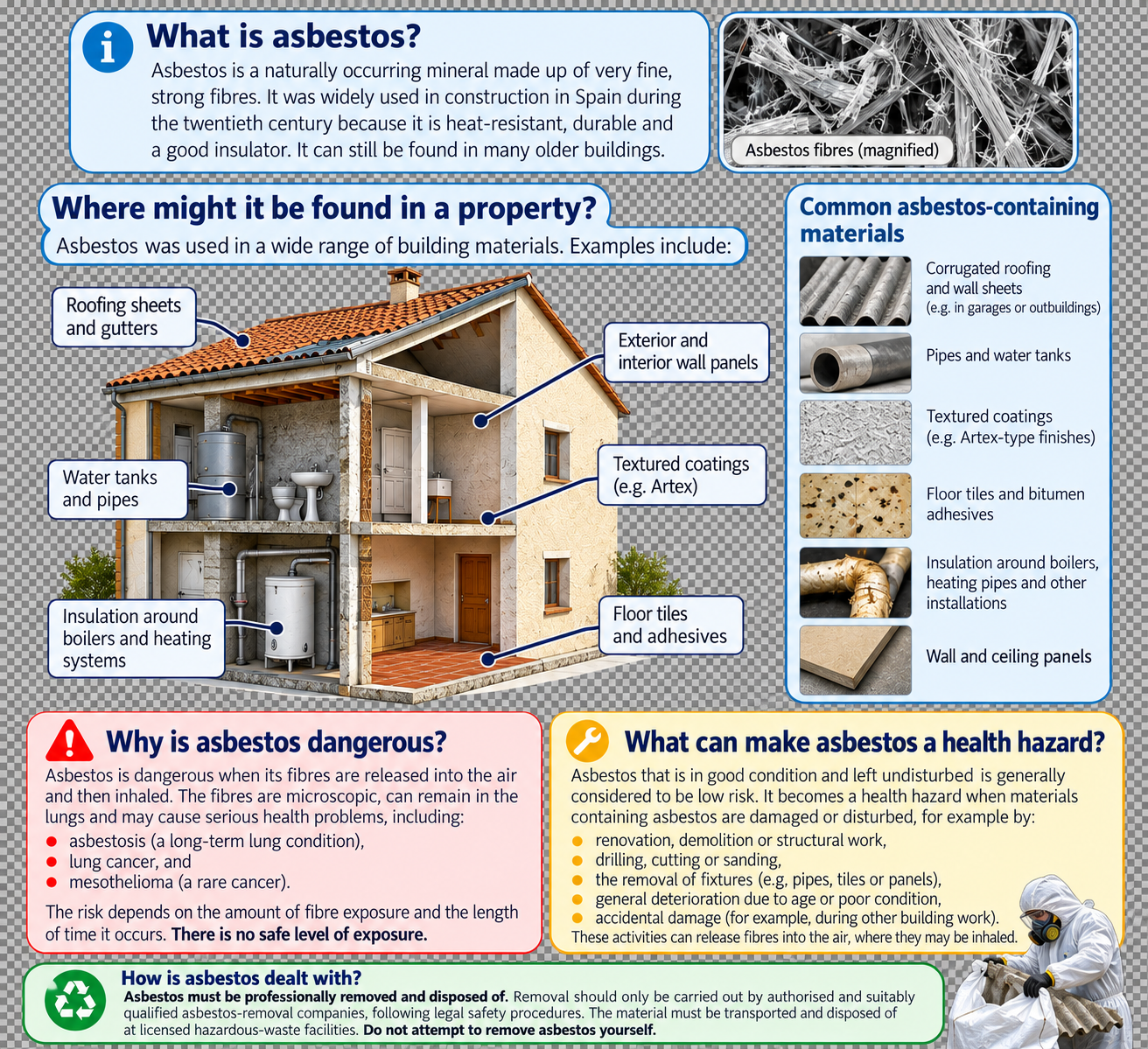
Why can asbestos suddenly become a problem after decades?
Asbestos was widely incorporated into twentieth-century construction products because of properties such as its resistance to heat and fire.
Asbestos-containing material can remain in place for many years without necessarily releasing significant quantities of fibers. Problems can arise when the material deteriorates or is disturbed.
That can happen during activities such as:
– drilling or cutting into asbestos-containing material;
– removing walls, ceilings, flooring or insulation;
– replacing old pipes or roofing;
– sanding or scraping surfaces; or
– demolition and major renovation work.
When asbestos-containing material is damaged or disturbed, microscopic fibers can become airborne. Inhalation of those fibers is associated with serious diseases, including asbestosis, lung cancer and mesothelioma.
This is one reason the new requirement is particularly relevant to buyers planning substantial renovations of older Catalan properties.
What should you do if you are buying a property?
If you are purchasing a pre-2002 property in Catalonia, ask the seller or the seller's representative for the “certificate of presence or absence of visible asbestos” (certificat de presència o absència d’amiant visible)**.
Treat it as part of your overall due diligence rather than simply as another document required to complete the transaction.
If visible asbestos is identified, consider obtaining specialist advice before committing yourself to the purchase—particularly if you intend to renovate. The potential cost and practical consequences of professional remediation can then form part of your assessment of the property and, where appropriate, your negotiations with the seller.
A note for readers of Buying Property in Catalonia, Spain
This requirement was introduced after the current edition of Buying Property in Catalonia, Spain – A Step-by-Step Guide for Foreigners was prepared.
I monitor significant legal and procedural developments affecting property buyers in Catalonia and publish important changes here between editions. The Due Diligence Companion Resource available on this website has also been updated to include the new asbestos-certificate requirement.
The Generalitat's current arrangements are interim. Definitive implementing regulations are still expected, so some details may change. I will update this article and the relevant Companion Resources if that happens.
Last updated: 5 October 2026
Official source: Agència de Residus de Catalunya, guidance on the certificate of presence or absence of visible asbestos and interim certificate model.
Readers who subscribe for updates will be notified whenever I add significant new information or resources.